
ISSN: 2158-7051
====================
INTERNATIONAL JOURNAL OF
RUSSIAN STUDIES
====================
ISSUE NO. 12 ( 2023/1 )
|
|
ISSN: 2158-7051 ==================== INTERNATIONAL JOURNAL OF RUSSIAN STUDIES ==================== ISSUE NO. 12 ( 2023/1 ) |
EKATERINA BLAZHKOVA AND THE EXCHANGE BETWEEN INTERNATIONALES MUSIKINSTITUT DARMSTADT AND LENINGRAD/SAINT PETERSBURG (1990-2000)
JOEVAN DE MATTOS CAITANO*
Summary
Through the efforts of the young musicologists Ekaterina Blazhkova in Leningrad, Friedrich Hommel, and Wilhelm in West Germany between 1990 and 2000, the Internationales Musikinstitut Darmstadt and Russia exchange was strengthened. The interplay of the letters that were sent reveals that a musical constellation was created. The IMD helped Blazhkova when she authored and defended the first academic work in Russian with regard to the history of Darmstädter Ferienkursen. For other Russian composers, such as Alexander Knaifel and Alexander Alexander Radvilovich, whose attendance to Darmstadt in 1992 and 1994 opened doors for the New Sounds Festival in St. Petersburg, which attracted musicians from Central Europe, Blazhkova's involvement was also significant. This article aims to reconstruct the background of the relationship between Darmstadt and St. Petersburg after the cold war. It is based on correspondence preserved at the IMD Archiv and Stadtarchiv Darmstadt, interviews with some musicians involved in that bicultural project, and specialized literature.
Key Words: Internationales Musikinstitut Darmstadt, New Music, Russian musicology, Ekaterina Blazhkova, Friedrich Hommel, Alexander Knaifel, Alexander Radvilovich, Sound Ways International Festival of New Music.
Introduction Many publications have already approached the Darmstadt
International Summer Courses for New Music, however, ignored the interchange between Darmstadt and
Russia (Hommel/Schlüter, 1987, 1989, Trudu,
1992, Stephan, 1996, Borio/Danuser,
1997, Beal, 2006, Clichy, 2009, Nonenmann, 2010, Iddon, 2013). Analysis of the role
performed by Russian representatives
who
made relations with the International Music Institute Darmstadt (IMD), whose
materials are housed in the IMD Archive, is another requirement when
considering Darmstadt in the context of the Cold War and the post-Cold War (Caitano 2019, Caitano 2022, pp. 16–29).
The involvement of musicologist Ekaterina Blazhkova,
who in the 1990s maintained close contact with Friedrich Hommel
(director of the IMD) and his assistant Wilhelm Schlüter in order to gather
information for his master's thesis at the Leningrad Conservatory and to
develop a project on the works of Arvo Pärt from 1977 to 1990, highlights the significance of the
Darmstadt and Leningrad interactions. Literature review Through some texts in German, English, French, and Italian chosen from
the IMD Archive, the history of the Internationale Ferienkursen
für Neue Musik in Darmstadt has been presented (Hommel/Schlüter, 1987 and 1989). These materials include
lectures by significant protagonists like György
Ligeti and others. Antonio Trudu, an Italian
musicologist, provided a thorough and chronological description of this event
based on the Darmstädter Ferienkurse's
programs (Trudu, 1992). A book of 72 articles giving
varied viewpoints from various authors who attended Darmstadt was published
during Ferienkursen's 50th-anniversary
festivities (Stephan 1996). The editors of “Im Zenit
der Moderne” envisioned a monumental work in 4 volumes
that also would include texts in Spanish and programming for Ferienkurse between 1946 and 1996 (Borio
/ Danuser, 1997). At the conclusion of World War II,
the North American Allies provided both financial and political backing for
Wolfgang Steinecke's creation of the Kranischteiner Ferienkurse für
Neue Musik (Beal, 2006, Clichy, 2009, Custodis, 2010). The concept of Ferienkurse
as the Bauhaus of New Music was approached in conversation with significant texts
that influenced Darmstadt's aesthetic developments (Nonenmann
2012). In a book devoted to the legacy of Boulez, Stockhausen, Nono, and Pousseur, the Darmstadt
School slogan was extensively discussed (Iddon,
2013). Although these musicological publications has
historical significance, it is mostly concerned with the connections between
Darmstadt and Central Europe The researchers did not include exchanges between
Darmstadt and Central Europe (Bulgaria and Ukraine). With a general approach to
the letter interchange established by the Internationales
Musikinstitut Darmstadt and musicians and
institutions in Russia, mostly in Moscow, the incorporation of the Darmstadt
and Russia connection is a new accomplishment ( Caitano, 2019, Caitano,
2022). The publication of this article, which focuses on Ekaterina Blazhkova's function as a key intermediary between
Darmstadt and Leningrad (St. Petersburg beginning in 1991), will broaden the exchange
that was for many years disregarded by Darmstadt's specialized musicology. First stage: The flowering of cooperation The
initial communication Blazhkova had with the IMD
suggests that she sought to get information about Arvo
Pärt (1975-1990). She claimed that these resources
weren't good enough in the USSR.[1]
The
Leningrad Conservatoire commissioned Blazhkova to
provide a thorough overview of
the 1990 courses in addition to an account of the history of the International
New Music Courses in Darmstadt from
1950 to 1990, including composers, works, activities, and orientations. She
also requested information on the Darmstädter Ferienkursen, a brief history, and other research resources
from Schlüter. The Russian musicologist also stated that she was willing to
lend books from the IMD library and make herself accessible for the IMD to
share with the Soviet Union.[3]
Schlüter
reported that the Arvo Pärt
composition "Berlin Mass" for choir, soloist, and organ (EC 19547),
which had been commissioned for the IMD collection, had been published by
Universal Publishers. The Pärt compositions' scores
were delivered to Leningrad. Schlüter provided the following information
regarding a Norwegian text about Arvo Pärt's music that was translated into English:
"Finally, there is a further paper about Arvo Pärt's music in the appendix: Saetherbakken,
Stig From the Norwegian
periodical Ballade 3. 90, "4 Notater under innflytelse av Arvo Pärts musikk" ("Four
notes under the influence of A. P. Music. - Author (Stig
Saeterbakkens)").[4]
Wilhelm
Schlüter oversaw the publication of several significant documents in Germany.
From diverse authors' perspectives, Darmstadt was discussed. He provided a list
of various texts, books, and journals
that Blazkova would find useful. Schlüter ordered
volumes 4, 13, and 19 of the Darmstädter Beiträge zur Neuen
Musik (Darmstädter
Contributions to New Music) series in support of Blazhkova's
second research
project
and informed her that she might find specialized data in Wien Modern 1990. The
IMD also contributed a specific statistic on Ferienkurse
from 1946 to 1980, presented for internal use, as well as copies of two
Darmstadt anthologies, Darmstadt in Amsterdam and Darmstadt in Milan.
The
goal of all of these materials and documents was to provide Blazhkova
with a
better understanding of Darmstadt in terms of the historical context and
significance of new music. A copy of "Darmstadt, the fortress of the
avant-garde," written by Brigitte Schiffer and published in
the quarterly World of Music
(World of Music. 1969. Vol. XI, No. 3), was enclosed. Schlüter
stated that this article's trilingual format was a major advantage.[5]
Ekaterina Blazhkova acknowledged receiving
many copies of the IMD and mentioned how important it is for her studies that
she has access to all of these resources: Brigitte
Schiffer, "Darmstadt, Citadel of the Avantgardeˮ,
Algorithmus, Klang, Natur: Abkehr vom
Materialdenken? (1984) (Algorithm, sound, nature:
turning away from material thinking? ), Darmstädter Beiträge zur Neuen Musik,
1961 (Darmstadt Contributions to New Music), 1972; Andreas Huschenbett:
Die Internationalen Ferienkurse für Neue Musik in Darmstadt - eine Beschreibung und Dokumentation
von den Anfängen bis 1958 (International Summer
Courses for New Music in Darmstadt – description, and documentation from origins to
1958) ... Written coursework.[6]
The symposium "Music Culture in the BRR today," which took
place in Leningrad from May 22 to May 26, 1990, with the involvement of Russian
and German musicologists, was mentioned by Blazhkova
as lacking access to conference materials. She requested that Friedrich Hommel provide her with the details of his 25 May 1990
lecture on "Darmstadt - International Music Institute and nearby Ferienkursen." She expressed interest in writing a
master's thesis.
Second stage: Ekaterina Blazhkova
in the Darmstädter Ferienkurse
(1990)
Ekaterina Blazhkova attended the Darmstädter Ferienkurse in 1990
as an IMD researcher when she was conducting fieldwork in Germany. John Cage
and Yannis Xenakis, two titans of contemporary music, were at Darmstadt for
this gathering as guests of honor [Gronemeyer 1990, 64; Hommel, Gronemeyer 1990, 42-45].[7]
Ekaterina Blazhkova and Franz Jochen Herfert met in the Ferienkurse
1990 while she was enrolled in his analytical course. She issued an invitation
for Herfert to attend the Festival
directed by Alexander Radvilovich in St. Petersburg
(formerly Leningrad) right away. F.J. Herfert was
glad to accept since he is a Russophile, and he found it to be quite intriguing
and quite different from the West there in the Soviet Union. 1990 in St.
Petersburg. Ms. Blazhkova presented the Leningrad
Union of Composers with examples of his scientific and artistic work. Herfert was invited by Alexander Radvilovich
as a guest speaker and composer at the Sound Ways festival and courses in Repino. The Leningrad composer's company was first launched
by Blazhkova, and Radvilovich
later supported this launch with a concert and conference directorship.[8]
Ekaterina Blazhkova planned a concert with a
contemporary music repertoire that year that included pieces by emerging
Russian, Italian, and American composers. Blazhkova
invited three incredibly talented musicians to the First International Festival
of Young Composers in Repino-Leningrad from November
12 to November 24, 1990: M. Garuti (Italy), F. Herfert, and A. Kalogeras. She
included their names in the concert's program, which was held on November 21,
1990, in the Leningrad Philharmonic Hall (USA). She wrote to Wilhelm
Schlüter: "We all recall your
kindness toward us in Darmstadt. Darmstadt was significant, and our composers
had productive conversations there. Our interactions go on."[9]
The attendance of Ekaterina Blazhkova in
Darmstadt also coincided with a wave of opposition against the conventional
music production and realization system. The essay "Restructuring in
Darmstadt," written by Roland Schmener and Friedemann Schmidt-Mehau,
bemoaned the Darmstadt Ferienkursen's neglect of
significant musical genres like jazz, rock, improvisation, and performance art.
It argued that Darmstadt had become a hub for only "new complexity"
and the maintenance of Darmstadt academism (Trudu
1990, pp. 293-301).
Third stage: Defence of the Master's thesis in 1991
Wilhelm Schlüter got in touch with Ekaterina Blazhkova
in 1991 and expressed surprise and an outstanding memory of the "Darmstadt
Faculty" conference in Leningrad. According to Schlüter, the concert
program that was given as an attachment was analyzed
at IMD, and they were eager to see photos from the occasion. Schlüter saw to it
that other publications were delivered to support the Russian musicologist's
research and that a copy of Friedrich Hommel's lecture
from the Leningrad Symposium in 1990 was retained in the IMD archives.[10]
In her reply, Ekaterina Blazhkova also asked
for the papers' due date to be pushed back to April. The Russian musicologist
argued that she needed more time to thoroughly examine the material that the
IMD had previously borrowed. She based her research on two papers that were
presented at a symposium in Leningrad: "Darmstadt - International Music
Institute and its Summer Courses (Leningrad, 25. 05. 90)" and "Is
there a Darmstadt School?" by Professor Dr.
Hermann Danuser of Freiburg University.[11]
Friedrich Hommel and the young musicologist
Ekaterina Blazhkova met in Leningrad. Two research
initiatives created by Ekaterina Blazhkova, required
the assistance of individuals and organizations in West Germany: Darmstädter Ferienkursen and Arvo Pärt’s works from 1975 to 1990.
Blazhkova worked closely with the IMD to write her
master's thesis on "International Darmstadt courses on the impact of new
music. Main periods, specificity of musical and communicative situation,
contemporary practice" under the guidance of Professor Larissa Danko.[12]
The dissertation, which was defended in 1991, was structured of an
introduction, two chapters, a conclusion, and three appendices. This academic
dissertation solidified its position as the first scholarly work in the Russian
language. For composers, musicians, and musicologists, Ekaterina described the
Darmstadt phenomenon as a unique method of disseminating new music in culture (Blazhkova 1991). She completed her master's thesis at the
Leningrad Conservatoire, and the city of Darmstadt honored
her engagement by awarding 1000 marks as a reward for innovative work that was
created in challenging circumstances.[13]
The IMD and Ekaterina stayed in touch until 2000 after the master's
thesis was finished in 1991 in order to update information on the Arvo Pärt project. Evidence found
in the Stadtarchiv Darmstadt demonstrates that ECM
Records in Munich worked with the IMD and supported the Leningrad project in
1992. Other composing scores and recordings of Pärt
from Germany to Leningrad were made feasible in this collaboration.[14]
She worked with Alexander Knaifel on a
WRD-sponsored project in which he presented his work to German audiences, which
highlights her engagement in promoting new music created in Germany and Russia.
Ekaterina sent a research proposal to Professor Martin Schmidt at the Technical
University of Berlin with the intention of preparing a doctoral thesis that
would examine Arvo Pärt's
works between 1975 and 1990.
Fourth Stage: Blazhkova as the mediator between IMD and the other Russians at the Darmstädter Ferienkurse in 1992 and 1994: The effect of Darmstadt on Russian festivals
In 1992, Blazhkova attended the Darmstädter Ferienkurse thanks to
a grant from the city of Darmstadt. At the time, the IMD was struggling and had
limited money to support participants. For the reason of Blazhkova
and Hommel's ties, Alexander Kneifel
and his wife Tatiana Melentieva were invited to
Darmstadt. They appreciated the wonderful ambiance and excellent musicianship
that promoted cross-cultural understanding. Knaifel
and Melentieva met the shō
player Mayumi Miyata.[15] Knaifel had the chance to take in Tatiana Melentieva and Oleg Malov's
performance of “A Silly Horse” [Fifteen Tales for Singer (Female) and Pianist
(Male)] at the Ferienkurs 1992 (Gronemeyer,
Oehlschlägel 1992, 142-146).[16]
Alexander Knaifel sought a musical language free of
specific stylistic color and fleeting connotations in
this work, as well as in his other mature works (Savenko
1994, 174-188, Savenko 2003, 88-92; Knaifel 2013).
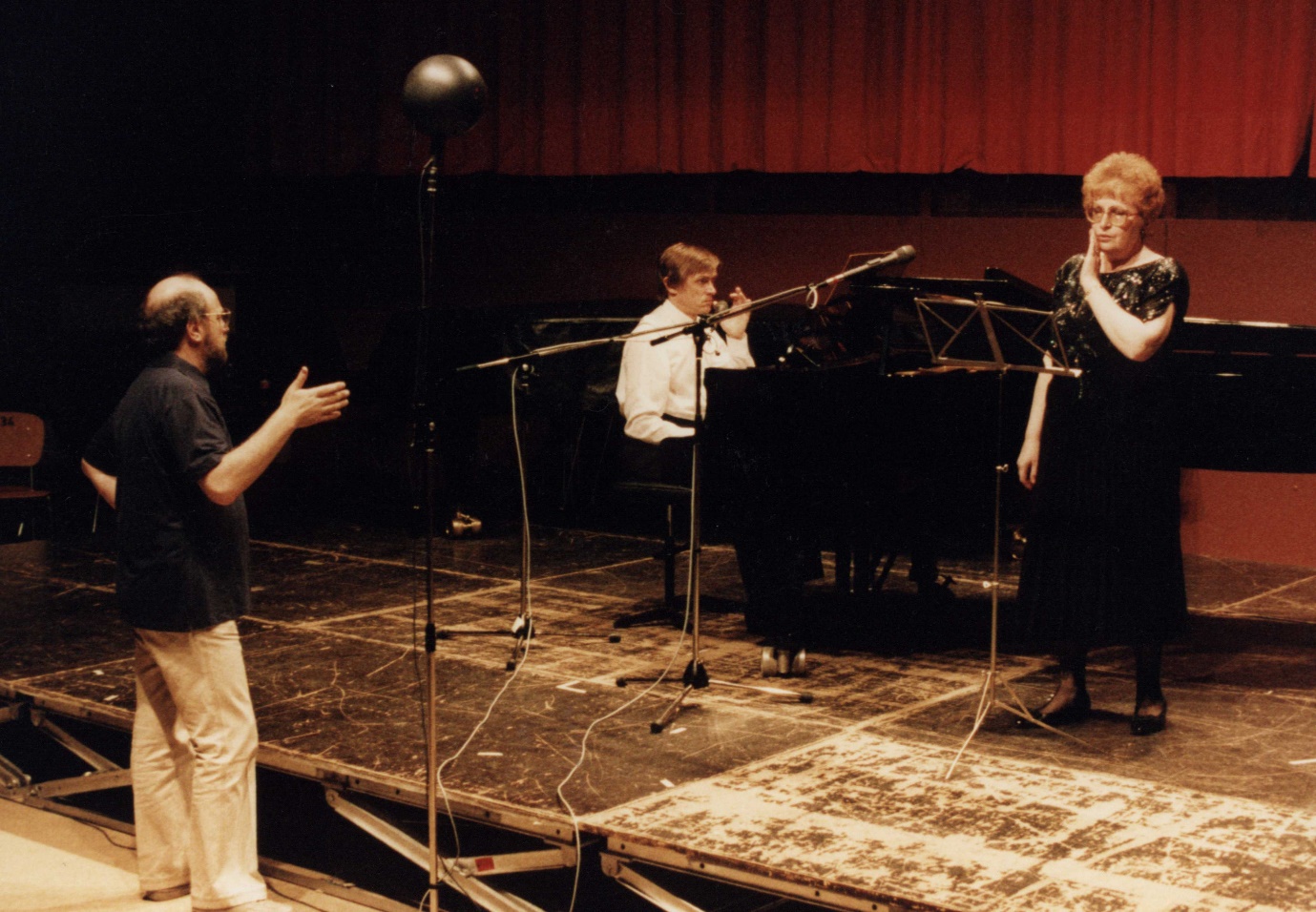
Figure 1
Alexander Knaifel, Oleg Malov, and Tatjana Milentieva rehearsing during the Darmstädter
Ferienkurse 1992.
Photographer:
Sascha Müller
Signature:
IMD-B3007028
IMD Archiv
Alexander Radvilovich visited Darmstädter Ferienkurse in 1992
thanks in part to Ekaterina Blazhkova's efforts.
Thanks to the many contacts, musical, and organizational concepts he has since
adopted and incorporated into his creative work, as well as the Sound Ways
festival, Radvilovich has had wonderful musical
impressions of Darmstadt. The composer invited to St. Petersburg composers such
as Klaus Heinrich Stamer, Franz Jochen Herfert, Ernst Helmut Flammer, Horatiu Radulescu,
Giuseppe Giuliano, Karin Levine (Florida), James Clapperton, Ortwin Stürmer, and the Freiburg-based
Recherche Streichtrio Ensemble.
Radvilovich acquired numerous scores while
attending Darmstadt, and these scores were later performed in St. Petersburg.
In addition, Brian Ferneyhough and director Friedrich
Hommel were invited by Raddvilovich.
Unfortunately, Hommel did not reply to the
invitation, and Ferneyhough declined to travel to St.
Petersburg at the last minute in 1994 out of concern about Western journalists
covering Russian life. Journalism from Europe and North America only used
negative adjectives to characterize the mood in Russia. Peter Veal declined to
travel to St. Petersburg in 1996, perhaps for the same reason.[17]
Additionally participating in the summer session in 1994, Radwilowitsch gave a lecture titled "Religious Motifs
in Contemporary Russian Music." In Darmstädter Ferienkursen, he was the first Russian speaker, and his
lecture was translated and published in German [Radwilowitsch
2000]. In 1994, he performed De Profundis on two pianos with pianist Bernhard
Wambach. When Radwilowitsch established the festival
"Sounds Ways," which celebrated the works of emerging composers, in
1989, he served as a vital conduit between Darmstadt and Leningrad.
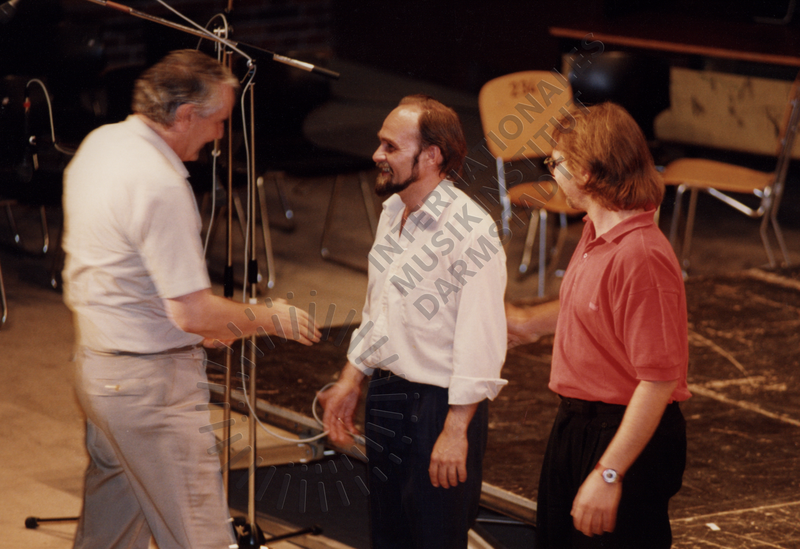
Figure 2
Friedrich Hommel congratulates Alexander Radvilovich and Ulrich Löffler
during the Darmstädter Ferienkurse
1992
Photographer:
Sascha Müller
Signature:
IMD-B3007031
IMD Archiv
The instrumentalists must locate their time, characters, and dynamics
when recording extremely complicated musical excerpts since sometimes doing so
is pretty straightforward and traditional. In this way, the interpreters become
co-authors in a joint writing project. Alexander Radilovich
and Brian Ferneyhough disagreed on this matter.
According to Ferneyhough, the musical material should
be meticulously and intricately recorded to provide the interpreter with the
greatest sense of responsibility when performing his work. At Ferienkursen 1992 and 1994, both points of view currently
diverge.[18]
Meeting foreign composers in November 1990, with assistance from the
Leningrad Composers' Union and the festival director, was one of the most
significant outcomes of her mission to Darmstadt. Some composers who attended Darmstadt were
asked to take part in the festival in Leningrad with the support of the Union
of Composers of Leningrad and Alexander Radvilovich,
the Sound Ways festival's director. Eminent and beginners Leningrad composers
participated in this festival together with overseas visitors. At the time, it
was a very noteworthy event that sparked a lot of attention among those working
in the music industry. All master classes and lectures were translated by Blazhkova and her colleague. The "Fall of Stone
Circles" article was the result. The Leningrad Philharmonic hosted
festival concerts [Blazhkova, Gnatenko
1991, 48–54].
With the help of Alexander Radvilovich and
thanks to Blazhkova's involvement, the International
Summer Course of New Music in Darmstadt was disseminated to the Association of
Russian Composers and successful concerts with F.L. Herfeld
and his wife were organized. Later, Alexander Kalogeras
participated with the Philharmonic Orchestra at the New Music Festival
"Avant-garde and Our Days."
Leningrad was renamed St. Petersburg in 1991, and the International
Festival of New Music Sound Ways adopted its name and did away with the
composers' age limitations. Several musical languages became apparent after the
first direct interaction with international colleagues at the inaugural
festival. In 1990, 1992, 1994, and 1996, Radvilovich
held the Festival with a large concert program as a
result of this exchange from 1989. The "Darmstadt Seminar on the
Neva" was the name given to these gatherings in the newspapers. Due to the
Conservatoire's conservative teachers' objections, the Seminar was unable to
continue in 1997. It is noteworthy that musicologists Olga Manulkina
and Ekaterina Blazhkova, who later excelled in their
professions, attended the first Seminar (1990). E. Blazhkova
also suggested bringing in a number of international artists to the first
Seminar, whose presence turned it into an intriguing musical occasion (Blazhkova and Gnatenko 1991:
48-54).
1993, Blazhkova reestablished
touch with Schlüter and expressed gratitude for his efforts and friendship. The
IMD made sure that she had a musically rich stay at Ferienkurs
1992, enriching her profession as a musicologist organizing events in St.
Petersburg.[19]
As part of his ongoing
assistance to Blazhkova, Schlüter sent her a number
of Arvo Pärt's scores,
including Passio, Arbos,
Song of the Silsans, Blessings, Credo, and Passio for wind and percussion, as well as Fraternities for
cello and piano. This came about as a result of tight cooperation between IMD
and ECM Records, with the assistance of composer Dieter de la Motte
(1928–2010). Dieter De La Motte allegedly assisted Ekaterina Blazhkova with her initiatives through correspondence
between the two parties between 1989 and the mid-1990s. Helga De La Motte, a
German musicologist, served as the mediator, according to Blazhkova.[20]
Ekaterina informed that Mr. Rainer Cartres Sovitz of the publisher Bärenreiter
had sent Darmstadt a copy of Oswald Jonas' book "das Wesen
des musikalischen Kunstwerks"
(the essence of a musical work of art) in the same correspondence. He traveled to St. Petersburg in the fall as a result of a
connection made at the 1992 Darmstädter Ferienkurse, which led to a partnership between that
publisher and the St. Petersburg Conservatory of Music, which supported the
exhibition and other activities. She was teaching professors, students, and
other artists about the value of the Internationales
Musikinstitut Darmstadt for the presentation and
popularization of new music at the time while also working as a translator and
assistant professor at the Conservatory of Music. She stated that professors in
St. Petersburg had advised her to carry out more research on Darmstadt Ferienkursen. She planned to develop distinct creative
challenges based on the music of Lachenmann, Kagel, Rihm, and Herfert.[21]
Alexander Knaifel helped Blazhkova
connect with Darmstadt in 1993 while he was a DAAD fellow residing in Berlin. A
cassette tape of the Russian-language radio program Aesthetics and Music of
Alexander Knaifel was provided to IMD by Blazhkova, who stated that she was composing a manuscript
about Knaifel's compositions. The musicologist hoped
that someone at Rundfunk Deutschland (Broadcasting Germany) could be interested
in the program. If so, she would send a German translation, the full soundtrack
without text, interviews without music, and any excellent musical content on CD
in digital format.[22]
“Magnificat,” “Sieben”, “Magnificat – Antiphonen,
"De Profundis," “Mein Weg has Gipfel und Wellentäeler,"
and "Credo “ by Arvo Pärt were sent in six new versions in 1996, and Blazhkova thanked Schlüter for sending them. With the
backing of Mr. Andrei Petrov, president of the St. Petersburg Conservatory, and
the vice-president, she stated in the correspondence that she was looking
forward to a visit from Solf Schäfer, IMD director,
and potentially an interview in the fall. Compared to Darmstadt, the Russians
were highly curious to learn more about the state of and tendencies in modern
music.[23]
Despite his best attempts, Solf Schaefer has not
created any projects with Russia while he was an IMD director from 1995 to
2008.[24]
Theoretical explanations for Alexander Knaifel's
research have been compiled throughout the years by Ekaterina Blazhkova from various authors. She contacted IMD for
assistance in acquiring access to some of the publications that referenced Knaifel, such as “Komponisten der
Gegenwart” [Composers of the Present], edited by H.
H. Heister and W.-W. Sparrer, Textekritik Edition,
Munich, 1992.[25]Schlüter
allegedly did not reply to the fax sent on January 11, 1996, according to Blazhkova.[26]
In 2000, Blazhkova and the IMD's partnership
was formally ended. She moved to Canada in 2006 along with her husband and two
kids. She was chosen after an interview as a music professional who could fit
in with Canadian music and educational environments. This was professional
immigration. She continued to collaborate with Russian music publishers and
composers at the same time. Alexander Knaifel's
compositions were promoted in Canada by Ekaterina as well.[27]
Discussion
The broad field of the reception of Russian Music in Darmstadt has only
in recent years become a central topic in discussions of contemporary music,
which also and especially, as Joevan Caitano (2019) wrote in his fundamental study
"Intercultural perspectives in the Summer Courses in Darmstadt", is
able to capture the confrontation of composers from countries outside Central
Europe with very specific expectations. Among the Russian composers who were
active in the Darmstadt Summer Course at various times, the interest in the
exchange of ideas is remarkable. In the late 1940s and early 1950s, Hans Mayer
exchanged correspondence with Wolfgang Steinecke
(director of the Kranichsteiner Musikinstitut Darmstadt from 1946 until 1961) which
culminated in a lecture on the situation of new music in the former Soviet
Union, with a focus on Russia (Kovács 1997, Caitano 2022).
At the inaugural Muzički Biennale
Zagreb, which was established by the composer Milko Kelemen, guests such as
Wolfgang Steinecke and Karen Khachaturian (President
of the Association of Soviet Composers) met in 1961 (Kelemen 1997, Caitano 2023). The diplomatic ties between Moscow and
Darmstadt were strengthened during that meeting. Later, the Kyiv avant-garde
music collective's members Leonid Grabowski, Valentin Silvestrov,
and Igor Blashkov were given scholarships to attend
Darmstadt, but they encountered a bureaucratic roadblock. In an effort to bring
the three Ukrainians, Wolfgang Steinecke made a lot
of effort and got in touch with Karen Khachaturian, but he was unsuccessful in
getting a travel visa (Caitano 2019).
In the early 1960s, the renowned Russian pianist Sviatoslav
Richter was invited to lead piano seminars at the Darmstädter
Ferienkursen. In that same decade, the composer
Edison Denisov also communicated in French with Ernst Thomas at the Internationales Musikinstitut
Darmstadt, through the intermediary of Paul Moor and Fred Prieberg.
Denisov's work “Le Soleil des Incas” was performed at the Darmstädter
Ferienkurse in 1965. In the following years, the
recording of this work preserved in the IMD Archiv
was disseminated to various institutions abroad by means of distance loans (Pierre-Armengaud 1993, Schlüter 2006).
In the 1970s the director of the Central Museum of
Musical Culture M.I. Glinka in Moscow exchanged letters with Ernst Thomas and
Wilhelm Schlüter at the IMD. Sheet music, recordings of works, and concert programs
were sent by both parties in a bicultural exchange.
In the 1980s, at the end of the cold war, Darmstadt remained a platform
that attracted Russian participants. In 1988, the work "In Deo speravit cor meum"
by Edison Denisov was performed in Darmstadt with the participation of the organist
Oleg Yantschenko. Between 1981 and 1994 Friedrich Hommel headed the IMD and implemented various projects to
bring composers, instrumentalists, and lecturers from other continents,
including Oleg Yantschenko who was officially invited
to play concerts in Darmstadt and other cities in programs linked to the Darmstädter Ferienkurse 1988. Sofia
Gubaidulina's compositions for piano and organ were
played during the Ferienkurse in 1988 and 1990. In
the Darmstädter Ferienkurse
of 1988, Friedrich Hommel's project also included a
concert with the Ensemble Madrigal and Pekarskij
Ensemble from Moscow (Trudu 1992). In a letter of
appreciation to the director Friedrich Hommel, Rashid
Kalimullin stated that he participated in the 1992 Darmstädter Ferienkurse and found
the experience to be helpful because it improved the aesthetic of his Kazan
career. Rashid Kalimullin subsequently gained
prominent roles among Russian composers. Oleg Malov,
a pianist, performed Galina Ustwolskaja's Sonatas 2,
4, and 6 at “Piano-Forum: Russian Piano Music”, which was part of the Darmstädter Ferienkurse in 1992 (Caitano 2019, Caitano 2022).
The engagement of the musicologist Ekaterina Blazhkova
in the 1990s which made possible the participation of Alexander Knaifel, Tatiana Melentieva, Oleg
Malov, and Alexander Radvilovich,
continued the exchange trail between Darmstadt and Russia developed by other
protagonists during the cold war. In 2006 Ekaterina Blazhkova
migrated with her family to Toronto, however, the Darmstadt-Russia connection
continued with other composers and instrumentalists who attended Darmstadt with
passives and actives. Among the Russian speakers who have contributed to the
history of courses in Darmstadt in the 21st century are
the composers Vladimir Tarnopolsky and Sergej Newski.
Moving past certain one-sidedness in the popular perception of Darmstadt
will be necessary for the context of the envisaged interchange between
Darmstadt and Russia. For instance, conversations about the musical
compositions of Bulgarian, Yugoslavian, and Ukrainian composers took place in
Darmstadt and provided an international connection from an ethnological
standpoint. The discussion attempts to make the notion of a transnational
movement between this diversity of the former Soviet Union and post-Cold War
Russia conceivable by drawing on several Russian and Eastern European traditions.
At these points, it will be necessary to discuss a referral to the historian
Erick Hobsbawm’s insights, such as the notion that traditions and new music can
coexist (Hobsbawm 1983), much of which contradicts common understandings of
"progress" in music most often associated with Darmstadt.
Conclusion
A significant event in the history of the Darmstadter
Ferienkurse and the St. Petersburg Conservatory of
Music was the engagement of Ekatherina Blazhkova, which established Leningrad in Darmstadt and
Darmstadt in Leningrad in an institutional symbiosis and brought a dynamic of
reciprocal exchange to both sides, facilitating cultural exchange. The history
of music has been and is still being created by unnamed, outstanding
individuals who have contributed significantly to the cultural enrichment of
individuals and institutions. Ekaterina Blazhkova has
earned the title of transnational ambassador thanks to her actions during and
after the Cold War, which should establish her as a prominent figure in the
field of musicology.
[1]Letter Ekaterina Blazhkova to Wilhelm Schlüter. 20 April 1990, .
Stadtarchiv Darmstadt.
[2]Letter from B. Schlüter to E. Blazhkova. 5 May 1990, . Stadtarchiv
Darmstadt.
[3]Letter E. Blazhkova to B. Schlüter.
September 1990, . Stadtarchiv Darmstadt.
[4]Letter from Wilhelm Schlüter to E. Blazhkova. 2 October 1990, .
Stadtarchiv Darmstadt.
[5]Letter from Wilhelm Schlüter to Ekaterina Blazhkova. 2 October 1990,
Stadtarchiv Darmstadt.
[6]Letter from E. Blazhkova to V.
Schlüter. 25 November 1990, Stadtarchiv Darmstadt.
[7]Registration of Ekaterina Blazhkova
for the summer course. 27. 06. 1992. The 36th International Summer Course in
New Music 1990. St.Petersburg. Registration for the 35th International Summer
Course in New Music Darmstadt 1990. Blazhkova Ekaterina USSR, Russia,
Musicology. IMD Archiv.
[8]Email from Prof. Dr Franz Jochen Herfert to the author of this
article dated 29 December 2020. Interview with Ekaterina Blazhkova in 2020.
[9]Letter from E. Blazhkova to Wilhelm Schlüter. 25 November 1990.
Stadtarchiv Darmstadt. In the Stadtarchiv Darmstadt, the author found a copy of
this concert realized in Leningrad on the 21st of November 1990.
[10]Letter from W. Schlüter to E. Blazhkova. 4 February 1991.
Stadtarchiv Darmstadt.
[11]Letter from E. Blazhkova to W. Schlüter. 1991. Stadtarchiv Darmstadt.
[12]During fieldwork at the IMD Archive in 2018, the author was given
access to this MA thesis:
[13]Letter from F. Hommel to E. Blazhkova. 20 December 1991. IMD Archiv.
[14]Letter from W. Schlüter to Kolb. 21 September 1992. Stadtarchiv
Darmstadt.
[15]On September 21, 2016, Tatiana Melentieva
sent the author of this article an email.
[16]The IMD Archiv preserves the audio recording
during the performance of this work in Georg- Büchner-Schule in Darmstadt on 22
July 1992.
[17]Alexander Radvilovich's interview with the
author of this article in 2020.
[18]Alexander Radvilovich's interview with the author of this article in
2020.
[19]Letter from E. Blazhkova to W. Schlüter. 22 January 1993. IMD
Archiv.
[20]Interview with Ekaterina Blazhkova in 2020.
[21]Letter from Blazhkova to Schlüter. 22 January 1993. IMD Archiv.
[22]She stated: "There is a lot of music in St Petersburg and a
week ago I translated Slonimsky's Apollo and Marcia essay under the direction
of Talmi (Israel). There's a big music festival starting today. I continue to
study the music of Pärt and am finishing a course on 'New Music' for the St.
Petersburg Conservatory and, in collaboration with soloists, a series of
chamber concerts entitled 'Twentieth Century Musical Portraits' (Cage, Berio,
Stockhausen, etc.)." According to Blazhkova, Schlüter's assistance made it
possible to carry out each scheme. Friedrich Hommel and his lovely wife Carmen
Hommel received gifts from her. Because they attempted to conduct business in
St. Petersburg, Ekaterina waited for Mr. Schluch, the managing director of
Bärenreiter Verlag. Fax from Blazhkova to Schlüter. 11 April 1993. Stadtarchiv
Darmstadt.
[23]Fax sent from E. Blazhkova to W. Schlüter. 7 January 1996. IMD archive.
[24]Email sent by Solf Schafer to the author of this article. 2018.
[25]Fax from E. Blazhkova to W. Schlüter. 7 January 1996. IMD archive.
[26]Email from E. Blazhkova to the author of this article dated 10
November 2016.
[27]Ekaterina Blazhkova in an interview with the author of this article
in November 2020.
Bibliography
Lavrov I.A., Beal, A. C. (2006). New Music, New Allies: American Experimental
Music in West Germany from the Zero Hour to the Reunification. Berkeley: University of California Press.
Blazhkova, Е. (1991). INTERNATIONAL DARMSTADT VACATION COURSES OF NEW MUSIC. Main periods, specific character of musical–communicative situation, contemporary practice. The thesis to the Professional degree MASTER OF MUSIC. Ленинград.
Блажкова Е., Гнатенко А. (1991). Круги от упавшего камня // Искусство Ленинграда [Circles from a fallen stone // Art of Leningrad], 48–54.
Borio, G & Hermann Danuser
(eds.). (1997). Im Zenit der
Moderne. Die Internationalen Ferienkurse
für Neue Musik in Darmstadt
1946-1966. Volume 3. Freiburg im Breisgau:
Rombach.
Knaifel. A. A. (2013). Мост в Эдем
: Встречи [Bridge
to Eden : Encounters]. Санкт-Петербург
: Композитор.
Caitano J. de M. (2019). Intercultural
Perspectives in the International Summer Courses for New Music: The “Internationales Musikinstitut Darmstadtˮ in the context of exchanges with Latin
America, Africa, USSR, Oceania, and Asia: Ph.D. diss. / Hochschule für Musik Carl Maria
von Weber Dresden. Dresden.
Caitano, J. de M. 2022. “Russian music in
Darmstadt (based on archival materials).” Muzykal’naya
akademiya [Music Academy], no. 2, pp. 16–29,
doi:10.34690/233. (In Russ.)
Caitano, J. de M. 2023. INTERNATIONALE FERIENKURSE FÜR NEUE MUSIK IN DARMSTADT
FROM THE YUGOSLAV PERSPECTIVES, New Sound International Journal of Music, issue
60, pp. 229-268 (forthcoming)
Cichy. D. (2009). Internationale Feriekurse für Neue
Musik w Darmstadcie. Dzieje, rola i
znaczenie w mysli teoretyscznej, prakyce kompositorskiej i zyciu muzycznym drugiej polowy XX wieku. Kraków : Musica lagellonica.
Gronemeyer, G.
& Reinhhard O.
(1992). Jedem das Seine. Zu den Darmstädter Ferienkursen 1992 [To
each his own. To the Darmstadt Summer Courses. MusikTexte
46/47,
142-146.
Gronemeyer G.
(1990). Flohmarkcharakter
und rigoroser Anspruch. Die
Internationalen Ferienkurse für Neue Musik Darmstadt // MusikTexte
( Heft 36), 63–64.
Hobsbawm, E. & Ranger O. T. (1983).
The Invention of Tradition. Cambridge: Cambridge University
Press.
Hommel F., Gronemeyer G. (1990). Jeder erhält dieselbe Chance... // MusikTexte.( Heft 36), 42–45.
Hommel
F., and Schlüter W. (eds.). (1987). Darmstadt in Amsterdam. Musique pure dans
un siècle sale: new music Darmstadt 1950–1960. Darmstadt: Internationales
Musikinstitut Darmstadt.
Hommel
F., and Schlüter W. (eds.). (1989). Darmstadt
in Milano. Testi imaggini omagi. Lògica e poesia. Darmstadt ieri
e oggi. Milano, IMD.
Iddon M. (2013). New Music at Darmstadt. Nono,
Stockhausen, Cage, and Boulez. Cambridge: Cambridge Univ. Press.
Kelemen, M. (1997). Klangwelten: Beiträge,
Essays, Interviews. Wilhelmshaven: Florian Noetzel.
Kovács, Inge. (1997). “Die Ferienkurse als Schauplatz der Ost–West Konfrontation”, in: Gianmario Borio and Hermann Danuser (Eds), Im Zenit der Moderne. Die
Internationalen Ferienkurse Darmstadt 1946–1996.
Freiburg: Rombach, 116–140.
Nonnenmann R. (eds.). (2010). Mit Nachdruck.
Texte der Darmstädter Ferienkurse für Neue Musik. Mainz : Schott.
Pierre- Armengaud, J. (1993). Entretiens avec Denisov: Un compositeur
sous le regime sovietique. Paris: Editions Plume.
Radwilowitsch A. (2000).
Religiöse Motive: zu einem
speziellen Phänomen der neue Musik in Russland
// MusikTexte.
(Heft 83), 17–21.
Savenko S. (2003). The magic of Alexander Knaifel’s message // «Ex
oriente...III»: Eight Composers from the former USSR
Philip Gershkovich, Boris Tishchenko, Leonid Grabovsky, Alexander Knaifel,
Vladislav Shoot, Alexander Vustin, Alexander Raskatov, Sergei Pavlenko
/ Ed. by V. Tsenova. Berlin : Verlag Ernst Kuhn. P. 75–101. English edition only
(Studia Slavica musicologica:
Bd. 31).
Savenko, S. (1997). The magic of Alexander Knaifel’s
message. Book Underground Music from the Former USSR. Edited by Valeria Tsenova, 174-188. London: Harwood academic publishers.
Schlüter, Wilhelm. (2006). “Vier Jahrzehnte Darmstadt” [Four decades of Darmstadt]. In Ludwig
H. & Claus-Steffen M. (Ed:). Musik & Ästhetik. Heft 39, (07), 33-50.
Stephan R. (ed.). (1996).
Von Kranichstein zur Gegenwart: 50 Jahre Darmstädter Ferienkurse; 1946–1996. Internationale
Ferienkurse für Neue Musik.
Stuttgart : DACO-Verl.
Trudu A. (1992). La “Scuolaˮ di Darmstadt. I Ferienkurse dal 1946 a oggi.
Milano : Ricordi/Unicopli.
*Joevan de Mattos Caitano - Independent Musicologist and Kantor email: joevan.caitano@yahoo.com.br
© 2010, IJORS - INTERNATIONAL JOURNAL OF RUSSIAN STUDIES