
ISSN: 2158-7051
====================
INTERNATIONAL JOURNAL OF
RUSSIAN STUDIES
====================
ISSUE NO. 11 ( 2022/2 )
|
|
ISSN: 2158-7051 ==================== INTERNATIONAL JOURNAL OF RUSSIAN STUDIES ==================== ISSUE NO. 11 ( 2022/2 ) |
Singing and Russian as a Heritage Language among Canadian Doukhobors
Veronika Makarova*
In memory of my dear Doukhobor friends Peter
Pereverzeff, Eli Popoff, and Peter Rezansoff. Vechnaia pamiat’ v tsarstvii nebesnom/eternal memory in heavenly kingdom Summary
This paper examines the role of communal singing in the lives of Canadian Doukhobors, its connection with stories about the past, the role of singing in the communal life and the interactions with the heritage Russian language and its maintenance. The data comes from 54 interviews with Doukhobors conducted between 2012 and 2019. The methodology employed is based on Discourse Analysis of the interviews with manual themes extraction. The results of the study demonstrate that the three traditional forms of Doukhobor singing (psalms, hymns and folk songs) help to maintain the heritage Doukhobor Russian language. For many individuals in the community, this is the only remaining domain of Russian language use. The article proposes incorporating these genres in a language revitalization course for the community. Key Words: Heritage language, Singing, Russian, Canadian Doukhobors, Endangered language, Language maintenance.
Introduction This article explores the role of singing
in the lives of contemporary Doukhobors and the connections between singing in
the ancestral (Russian) language and the language use by Canadian Doukhobors,
as reported in interviews with the Doukhobor participants. Doukhobors (Doukhobortsy
or Spirit Wrestlers) are a religious, ethnic and cultural minority who
immigrated to Canada in 1899 to avoid persecutions in Russia for their anti-churchianism and pacifism including a refusal of doing military
service (Tarasov, 1982). The original number of Doukhobors upon arrival was
about 7,500 individuals. Due to intermarriages and lack of inflow of other
Doukhobors from Russia in the 20th-21st centuries, their
numbers have dwindled. While the numbers of the descendants of the initial
immigrant families could be as high as 30,000-40,000 by some estimates, the
number of individuals who identify themselves as Doukhobors was 3800 according
to Census 2001 (the last Canadian census which included “religion” question)
and it further decreased over the last 20 years due to the aging population
dynamics (Makarova, 2020). Most Canadian Doukhobors reside in British Columbia (BC)
and a smaller group in Saskatchewan (SK), with the rest of the Doukhobors dispersed
across the country. The
language spoken by Canadian Doukhobors was Doukhobor Russian, a variety of
Russian formed on the basis of late19th century Central and Southern
Russian dialects plus some loan words from the languages of Transcaucasia and
English as a lexifier in the 20th-21st centuries
(Makarova, 2019). Only some features of Doukhobor Russian (DR) have been
described so far for the religious language of the psalms (Schaarshmidt,
2008) and contemporary conversational language (Makarova, 2019) Russian
used to be taught at schools at some points in the 20th century in
the areas of Doukhobor settlements in BC and Saskatchewan, but language
teaching has been strongly reduced by the 21st century. In
Saskatchewan, Russian is not offered in any form at any educational levels. In
BC, Russian is taught in a kindergarten in Castlegar run by the USCC (Union of the Spiritual Communities of Christ), the largest
Doukhobor organization in Canada. Twin Rivers Elementary School in Castlegar
offers a Russian emersion for a few grades, and University of British Columbia
and University of Victoria offer Russian as a foreign language courses. Thus,
there are very few opportunities for young Doukhobor learners to acquire some
Russian even in the province where it is still spoken (BC). Doukhobor
Russian is still widely used in the community for reciting and choral singing
of psalms (religious texts or prayers containing the essence of the Doukhobor
teachings known as “The Living Book”) as well as for singing hymns or spiritual
songs (songs on the subjects of Doukhobor beliefs and history) and folk songs
(Makarova, 2017). This article focuses on the themes of Doukhobor singing and
the role of heritage Russian language in it, as they are described by the
community members in the interviews. Literature review Heritage languages Heritage language is understood here in a
broad sense as a language to which its speakers “have some family, ethnic or
emotional connection” (Polinsky, 2018, p. 514). The Russian
language was still acquired by the Doukhobors in naturalistic settings by the current
generation in their 70s-90s who have a very high proficiency in the language
and are bilingual in English and Russian. However, for middle-age and younger
generations it is only an “ancestral” language in which they do not have a
functioning proficiency. Heritage language may retain its importance
due to cultural and emotional connections, individual identities and diasporic
ties (Belz, 2003; Fishman, 1991). On the other hand, a minority language can subject its
speakers to “linguistic racism,” discrimination and alienation (Dovchin, 2019, p. 334). Despite this some minority communities are strongly
committed to maintaining their language even if it is marginalized in the
society (Meddegama, 2020). Most studies of
heritage languages are performed with the first to third generations since
immigration (e.g., There is a significant body of research on Russian as an
immigrant and heritage language (e.g., Antonova-Unlu et al., 2015; Isurin, 2011; Mustajoki et al., 2020).
The retention rates
for Russian as a heritage language are high across a number of different
contexts (Isurin, 2011; Otwinowska-Kasztelanic et al., 2019). However,
no studies so far have addressed Russian as a heritage language spoken by Canadian
Doukhobors (who are 4-5th generation Russian language speakers since
the original immigrant group) and the connections between language and music in
this context. Languages and music The bonds between
music and language can be particularly strong in case of minority languages.
For example, they can be expressed through songwriting in Sardinian in Italy
(Jacobsen, 2019), listening to particular historic songs in Afrikaans by its speakers in South Africa (van der
Waal & Robins, 2011), or through bilingual rap lyrics by Chinese Americans (Chen & Leung,
2018). In a study by Fung, (2017, p. 17), an ability to engage in church choir
singing by Chinese Americans “preserved their ethnic languages, religious faith,
and cultural heritage and promoted personal development and emotional
well-being.” Music and songs have therefore become a widely accepted tool in foreign
and second language learning (e.g., Alisaari & Heikkola, 2018; Castelo, 2018; Rosowsky,
2010). In recent years, music and language connection has been employed for
language retention. For example, some indigenous communities have found ways of
attracting youth to learn their endangered languages through popular music
genres sung in these languages (Ramsdell, 2020). Music and songs have been found
motivating for different heritage language contexts, such as learners of Gaelic
on Cape Breton island (Canada) (Macintyre, Baker &
Sparling, 2017) and Greek in
the UK (Charalambous & Yerosimou 2015). Some teachers and communities combine
music, language, drama and dancing classes to teach heritage language and
culture to children, e.g., Sri Lankan immigrants in Australia (Nethsinghe, 2009). To the best of our knowledge, connections
between Doukhobor heritage language and music with perspectives for language
retention have not been explored before. Doukhobor
choral singing
The three major traditional genres of
Doukhobor music are psalms (psalmy), hymns (stikhi) and folk songs (pesni)
(Makarova, 2017). A capella singing is an intrinsic
part of Doukhobor spiritual practice and lifestyle (Mealing,
1989). Doukhobor mass and group singing “remarkably
preserved throughout the ages” has been called “soul expressive” (Popoff, 2005,
p.1). Doukhobor choral singing has attracted some
attention in earlier research due to its “harmonic sophistication” and its
reflection of Doukhobor beliefs not only via their words, but also through the togetherness
of choral singing which is a manifestation of Doukhobor ideas of universal brotherhood
(Peacock, 1966, p. 11-12).
The
first and foremost function of Doukhobor choral singing is spiritual and social
unity of the community (Mealing, 1989). Doukhobor sobranie (prayer services including the social part) and molenie (the spiritual part of the sobranie)
included choral signing of psalms and hymns. At the end of the sobranie,
some folk songs could be performed as well (Makarova, 2020).
Singing of the Psalms
Doukhobor psalm called “Singing of the
psalms” summarizes their spiritual significance:
The singing of psalms is an adornment to
our souls. It brings angels to our help — drives away darkness, creates
holiness, strength for the mind of man, effaces sin. …It drives away sin, it
teaches all, it reveals all, it honours the soul, it
cleanses sense and gladdens the heart, it builds the high pillar, it enlightens
man, it opens the senses, it destroys all evil, it reveals perfection. Serenity
of mind — it is the proclamation of peace (Mealing, 1989,
p. 54).
Psalms are prayers expressing Doukhobor beliefs that have been
passed in the oral tradition through centuries. Some of the psalms were set to
music, some were only recited, but not sung. Psalm texts include retold episodes
from the Bible and New Testament; inspirational and instructional texts
composed by the Doukhobor ancestors (17th-19th centuries)
and texts created by Doukhobor leaders to reflect their ideals and values.
These Russian texts constitute the foundations of Doukhobor beliefs. About 400 Doukhobor
psalms were transcribed and compiled into The Living Book of the Doukhobors
by a Russian anthropologist Bonch-Bruevich (1909). Some
later collections of psalms have been also published by the Doukhobor community
in Canada (e.g., Kalmakoff, 1991).
The
significance of Russian language psalms in Doukhobor culture has been pointed
out in Mealing,1989, and their multiple idiosyncratic music features have been
examined in Perry, 1992. Psalms are also a unique Doukhobor communion with God,
who according to Doukhobor worldview, is present in each person.
Psalmody
includes an element of improvisation, a freedom for a singer to form one’s own
harmony to compliment others. Psalms are sung extremely slowly with one
syllable stretched to multiple bars of music; therefore, singing just a few
words can take 10-15 minutes (Peacock, 1966; Makarova, 2017). The first of
multiple explanations of this tradition is their origin in very old medieval
music (Peacock, 1966, p. 16). Another explanation is that the vowels were
deliberately stretched out to prevent the authorities from understanding the
heretical meanings of the psalms (Perry, 1992). Mark Mealing
(1989, p. 118) suggests that Doukhobor psalms are rooted in the lost Russian
Orthodox Znamennoe chanting tradition. One more
explanation attributes the origins of the psalms to the impact of Buddhist
mantras passed through Doukhobors of Kalmyk ethnic origin (Psalmist Project). E.
Popoff (2005, p.1) relates the stories of psalms origins from the “ancient ritual of the chanting of funeral dirges” and their
use at the “times of persecutions of the early
Christians.” In any case, Doukhobor psalmody is an ancient unique tradition and
its origins are clad in mystery.
By
the beginning of the 20th century, singing of psalms has been
discontinued in Saskatchewan, and their function was replaced by reciting
psalms and other prayers and singing hymns. In a larger Doukhobor community of
British Columbia, psalms are still sung, although the number of performed
psalms has decreased from hundreds (in the early 20th century) to
about thirty nowadays (Makarova, 2017). Thanks to a group of BC Doukhobor
enthusiasts, psalm singing tradition is being continued, although longer psalms
are not sung in their entirety, but only the first few lines. A Psalmist
project also contributed to preserving them (Psalmist Project). USCC (the
largest group of Doukhobors in Canada) encourages psalmists and started a
tradition of sending a few records of hymns and psalms to its members once a
week by e-mail.
The
language of the psalms is archaic, and employs words and expressions from
church Slavonic as well as 17-19th century Russian forms, it is
therefore not easy to understand (Schaarshmidt, 2008).
Hymns
are much more contemporary from the viewpoint of history, musicology and lyrics.
Some of them were composed by the Doukhobor ancestors in Russia, some are shared
with other Christian sects. There are hymns celebrating Doukhobor history in
Russia and in Canada. A few hymns were
composed by Doukhobor leaders (Perry, 1992). In addition, the author adds to
this classification a group of hymns which have lyrics that came from works by
Russian poets.
The
tradition of Doukhobor hymnody (as well as of folk singing) was reformed a few
times in the 20th century. The reforms included changing to 4-part harmony and organizing choirs that performed the hymns and songs in
public (Tarasoff, 1982). These activities swung the singing of hymns over the
psalms.
Folk
songs are of Russian (mainland) origin, and there is little specificity about
them. There was a considerable cultural exchange in mid-late 20th
century with Russia, with choirs from both sides travelling across, record
exchange, etc. Some Russian songs lyrics have been changed to represent
Doukhobor beliefs (Makarova, 2017).
Solo
singing does happen at Doukhobor events nowadays, but is not very common. At
festivals and community events, one can hear small group singing as well (duos,
trios, quartets, male choirs, women choirs, etc.).
While
there have been a few studies of Doukhobor music and of Doukhobor language
cited above, there has been no investigation of the connection between Doukhobor
singing and heritage Russian language as they are expressed by community
members. This study is aimed at pursuing this connection. The research
questions of the study are:
What
is the significance of signing for the participants?
How
did the Doukhobors learn singing?
What
is the value of Russian language in connection to singing?
What
are the participants’ perspectives on singing and language retention?
Materials and Methods
This paper reports the results of an analysis
of 57 semi-structured interviews conducted by the author between 2012 and 2018
with Doukhobor community members. The average length of the interviews was 43
minutes; the average age of participants was 77 (with a range between 10 to 96
years old). The interviews were originally conducted with two purposes: to
obtain samples of Doukhobor Russian and to explore community values. The participants were not restricted to the research
questions, and they were free to talk about anything that interested them.
There were no research questions about Doukhobor music, but the themes of
singing emerged in the descriptions of childhood memories, knowledge learnt
from parents, Doukhobor beliefs, and Russian language maintenance. Transcripts of interviews were manually coded by the
researcher (employing Discourse Analysis thematic coding techniques - Waring,
2017). The interviews were conducted in the preferred language of the
participants – Russian or English and are presented here in the translations to
English due to article length limitations. BEH 09-156 approval (University of
Saskatchewan) was obtained, and all the research protocols were followed.
RESULTS Part 1. Singing
In this section, we summarize the singing-related
themes that were brought up by participants. Singing was the third most
frequent theme in participants’ interviews after pacifism and Doukhobor
beliefs. There was a total of 106 occurrences of the singing theme in the
interviews of 57 participants. The average number of the theme occurrences was
1.85 (SD=2.38), 40 participants (70%) talked about singing at least once, and
17 participants (30%) did not mention it at all. The summary of the frequencies of singing-related themes are represented in Figure 1. Most participants talked about Doukhobor singing once or twice, and one participant
brought up the topic of singing 14 times.
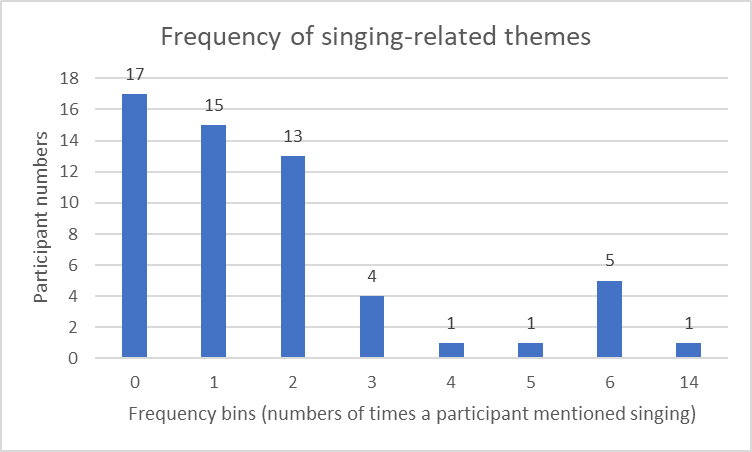
Figure 1. Frequencies of the themes of Doukhobor
singing in participants’ interviews.
Doukhobor singing and history
The
interviews demonstrate that singing is a part
of Doukhobor stories (“pаbaski”). According to one of them, an old wedding hymn
“There goes a young man crying bitterly” relates the story of the emergence of the
concept of the “Living book” as it was revealed to one of the founders of Doukhoborism (BC13-26).
One participant
brought up the story of connection between the Doukhobors and the Russian tsar
Alexander I, who is believed by the Doukhobors to have been impacted by their
singing and beliefs. The story suggests that one of the Doukhobor and Russian
Cossack’s songs “Oh, a Cossack was killed in Taganrog” is related to the
legends surrounding tsar Alexander I’s death in 1825 (BC13-30).
Signing of
the psalms accompanied all the important life events in Doukhobor history, such
as their moving to Canada:
Father came
from Russia, when he was only 12, and he told us that as they travelled on
board the ship, they thought the ship would sink, it was too bad, the waves
were huge, and everyone was very scared. And our people, whether they were
scared or not, they were singing right there that we would soon arrive in
Canada. Singing of the psalms was a major thing for them, and they brought many
psalms from Russia (SK1).
Doukhobor beliefs encrypted in psalms and hymns
Talking about the most important features of Doukhoborism, the participants mentioned that they are
expressed in psalms and hymns. For example, commenting on “thou shall not kill”
commandment, a participant mentioned that this message was conveyed through
singing:
And in our hymns we sing about this, our people were uneducated, but
how well they knew Russian, what hymns they were composing, what message they
passed over to people about their beliefs, how they suffered, and this is very
important for me (SK4).
Although Doukhobor singing is important, as one
participant reminded, they are less important than following Doukhobor
principles of living a good life and being nice to others:
Doukhobors
believe that the most important things are not to bow, not to sing, - all these
are secondary rites. But the most important thing, is so that other people
could live with you, this is important (BC13-26)
Moreover, singing was also a method of transmitting at
least some of these beliefs or at least some awareness of Doukhobors and their
message to the outsiders through choir performances:
We
participate a lot in Miltifaith, where they have
different religions’ choirs – Catholics, Muslims, Sikhs, and we perform our
hymns. And we were invited as Doukhobors (SK4).
Singing as a part of prayer services
Singing has always been an indispensable part of Sobranie (prayer services) practice. The service structure
emerged in Canada, as described by a participant from BC:
First, all the men will read the psalms,
and then all the women, and then they and the elder select which psalms they
want to sing. Then they sing, and then there is conversation, about the psalm,
beliefs, all sort of talk (BC18C-17).
Singing as a part of rites and mysticism
All major life’s events (marriages, funerals) were accompanied by the singing of the psalms and hymns. As one participant described a part of a traditional wedding ceremony: “Then everyone will read and sing Our Lord’s prayer” (BC13-25).
Psalms had deep spiritual and mystical meanings as
well: they were supposed to protect and
guide not only the souls of the living, but the souls of the dead as well.
Even
nowadays, we still have funerals in British Coumbia.
And I was told that one has to recite and sing three psalms, and then sing one
hymn. Only then your soul is ready to depart, but the soul is around six months,
maybe. It is around us (BC18C-09).
This traditional view that singing of the psalms is
required for the soul transitioning to afterlife was criticized by another
participant: “How bad does the funeral need to be for the soul not to get to
heaven?” (BS13-26)
Singing as a part of lifestyle
According
to multiple participant interviews, the singing tradition was very much a part
of everyday life:
We heard
some stories about gatherings in Russia. Some of our elders remember how they
got together, how they sang in the yards on benches, they started it this way
for us not to forget, and because there were no room in the houses (SK10-1).
Singing was also an intrinsic part of entertaining at
“vičirinki” (evening parties), and en-route:
And I
remember they had parties there, and they played Russian accordion, and sang. It was
fun listening to them and to feel that we are all together (BC18-05).
And when we
walk to the choir [rehearsal], we all get together and walk, sometimes we speak
about Doukhoborchestvo, about God, and we sing. It
was so much fun (BC18-05).
Some simple daily life activities, such as guests’
appearance, also required singing:
If we had
guests, we would sing the prayer “Guests”. This a psalm which is called
“Guests”. We had a hymn or a song or a psalm for every life’s occasion. And we
were ceremonial this way.
Singing was also a favorite pass-time during holidays:
They gathered for Christmas too, on Sunday evening.
They may play cards or sing, or eat seeds [sunflower]. This is how they spent
time (SK-5)
Having a good voice and remembering many psalms and
hymns among the Doukhobors was a “social grace” and a matter of individual,
family or group pride. A few participants spoke fondly of their older relatives
who could remember many psalms:
My aunt lived here, she died at the
age of 90, and she said “well I got a bit older, I
knew 70 hymns by heart, and now I am old and can only remember 50 (SK4).
In 1930s as well as in 1950-s-60s and later in 1980s,
many Doukhobor choirs were organized that performed all over Canada and even
abroad. Choir singing was a part of lifestyle of many Doukhobors, who “went
singing all over” (SK1). Doukhobor women took a major role in organizing choir
performances, as noted by one participant: “there are women in the community that take
leadership roles in organizing: choir directors, for example, coordinating
trips. Our choirs have gone to New York, to Russia, wherever” (BC18C-16).
For a few Doukhobors, psalmody still remains a way of
life. A total of six participants mentioned that they are “psalmopevtsy”
(psalm singers)
I go to
psalm singing on Wednesdays, we go to practice psalm singing in the evening.
And on Sundays we go to molenie (prayer service) (BC18-22).
It should
be noted that “spontaneous singing” is still very much a part of elderly
Doukhobor lifestyle. Three interviews ended up with singing of Doukhobor hymns
and folk songs by participants with the author happily joining in.
Learning the psalms texts and singing
The interviewees gave examples of how the singing of
the psalms (as well as hymns and songs) was memorized from early childhood.
Children first learnt to recite psalms and then sing them from parents and
grandparents in the family:
And then we were with grandmother, and I
learnt a lot, she taught me how to write in Russian and she sang a lot, she
even sang psalms alone, and I often heard how she sang (GF30)
I my vot s mamaj, s papaj, i s bratami časta peli duxaborčeskie stixi i psalmy.
And we
often sang Doukhobor hymns and psalms with mother, father, and brothers (GF19).
Children continued singing “acquisition” or
experiential learning in the community. It was picked up in prayer services,
and also during holidays and “singing” parties in the Doukhobor neighborhoods:
And of course
we learned when they sang at sobranija, we learnt the
hymns on the spot, we memorized them as we heard them (BC13-19)
We had interest groups, and we learned to
sing and the psalms. (BC18O28).
Some participants spoke about
singing in public from early childhood:
I remember
when she [the older sister] was standing on a table and sang for Verigin [P.P.
Verigin, a Doukhobor leader], and we stood with [the other] sister, and sang
harmonizing with her, when we were 8 years old” (SK 4).
As described by participants, the psalms melody was
extremely complex and involved lots of memorization:
Because one psalm has 29 parts. How do you
write them down? There is no way. Everything was learnt by heart. And now
nobody remembers, we have to read them (SK 3)
Emotional response to Doukhobor singing
A few participants (5) mentioned that listening to
Doukhobor singing in Russian was uplifting and made them feel better:
And they
[grandparents] sang the psalms a lot, and when you hear the words, it feels
good to live in this world (SK1.)
When we sing the Lord’s prayer…I goose-bumped
just thinking about it. It is something very powerful. You can feel this energy
about, you know. It’s almost like it’s hugging everybody (BC18C07).
One
participant metaphorically described the feeling of togetherness and
transcendence arising from Doukhobor singing:
I
love this singing. And I feel that when we sing like this together, it is as if
we are all weaving a fabric, every person who sings higher or lower, and
different voices, it is as if we are weaving a fabric. And I think that singing
together with others makes us listen to each other, and this is a part of
society, it is not all about me, bit about how to work together (GF19).
Results Part 2. Heritage language
In this section we will consider
participants’ responses to questions related to Russian language maintenance
and the connections between the language and the singing tradition. Out of a
total of 38 participants who answered the question about functions of the
Russian language, 19 respondents (50%) named “Doukhobor singing” (the most frequent
response).
Forty five participants answered a question whether Russian
language can be maintained or not; 37 (82%) of them answered positively, and 8
(8%) negatively. Forty three participants were asked
about the importance of Russian language for them, of those 33 (76%
participants) indicated that they had an emotional connection with the language.
Most participants said that their parents taught them Russian: 35 respondents (85%)
from a group of 41 participants. Thirty eight (97% of
39) participants mentioned that they taught Russian to their children, but of
these 28 participants (out of 38) explained that their children did not speak
Russian despite being taught it in childhood. Forty seven
(84%) of 56 participants regret the loss of Russian in the community.
Singing in Russian
One participant talked about Doukhobor singing
creating a motivation and an environment for practicing Russian:
We gathered
for singing, and I did not speak Russian all that well, and I did not read, but
you sing one song, and then you sing it once again, and then it got stuck in my
memory.
And when I
go to the sobranie, to singing rehearsals, whichever
older women are there, it is always interesting when we speak Russian. They
feel good about it. During sobranie we always speak
in English, but when we sit down to sing – it is in Russian, and we talk a lot
about different things. (SK 4)
The loss of meaning and the loss of language
According to one participant, understanding psalm
texts was a very important part of Doukhoborism, as
emphasized by the Doukhobor leaders P.P. Verigin and J. J Verigin the Elder:
Peter Petrovich and Ivan Ivanych repeated
the following: “You, he says, should know what exactly the essence of Doukhoborism is, in the psalms, whether you sing a hymn or
read a psalm, what does it mean and why it appeared amongst the Doukhobors? And
if you do not know this, then you are only acting following routine (BC13-26 ).
According to the participants, since 1970s-1980s, the
use of Russian in the community was on the decline. Even if Russian were
acquired, it was forgotten when the children left for studies or work
elsewhere. This created an issue with understanding the meaning of psalms,
hymns and songs. One participant described the way she addressed it through
explanations and translation:
We decided this way: if we are going
to teach psalms to the children, they have to understand what they mean, and we
had to explain almost every word to them. …So every
Sunday morning, we went and taught them, we explained things to children. And
it was very interesting for them. We translate for them in English what it
means, and they understand English, so when you explain to them, they
understand what they are signing about (BC13-21).
Erosion of Doukhobor traditions and heritage language use
Some participants’
comments about Doukhobor culture continuity were very pessimistic:
“Doukhoborism as
we know it is either finishing or has ended. No matter where you turn, there
are no Russian schools for children, no children’s sobranie,
psalm singing is very weak. The older grandmas and grandpas are dying. Here
there are some old timers who know psalmody well, but still, many psalms that were frequently sung
before are no longer sung, because they try to select the ones which are
easier” (BC18O27).
In Saskatchewan,
the singing of psalms has been discontinued for decades, as there are not
enough people left who remember how to sing psalms (SK 4). One participant said
that she could ‘sing along’ with a recording, but did not know and could not
direct who should “go” where melodically. Not only the singing of the psalms is
disappearing, but the reading of the psalms too: “now we have many prayers in
English” (SK3).
The disuse of Russian is explained
by multiple reasons, such as inability for others (non-Doukhobors) to
understand it:
When we did the vigil or funerals,
everything was in Russian. People came, but they did not understand. Of course,
the singing is good, people always like listening to singing, but they did not
understand what we were saying, and we started explaining that this is what we
are saying, and then people started understanding us. (SK3).
Young
people were getting away to get education, sometimes finding other religions to
follow, as there were no Doukhobor communities in other locations where they
moved to:
Then they all studied in Vancouver.
They did not have Doukhobors there. Our eldest daughter studied in Alberta. She
found a new church there and that was it. And she sang until she was 18-19
years old, everything in Russian, and then she forgot it all, and that was it
(BC13-21).
Poor or
insufficient teaching and learning of Russian were also blamed for the language
decline:
And I think with my peer group that's what happened because they took the Russian in school they didn't do the after-school Russian, they didn't come to Sunday school regularly and then they lost Russian (GF25).
I-phones, Internet and other IT gadgets may be contributing to distracting youngsters from learning …pretty much anything:
There are a lot of
youngsters on the Internet. That’s all they want - it’s the Internet. We were
in Kelowna, and there were two high school students there. And there was a big big concern: nobody wanted to study, and they only want to
be on their telephones (GF-6).
Increasing
numbers of intermarriages also caused the disruptions in continuity of
Doukhobor traditions. As a participant explained, her son married a woman from
another religion, and started going to his wife’s church, but was occasionally
“running away” to sing during Doukhobor sobranie, as
he had a “good high voice” (SK4)
Is there a hope for continuity?
Counteracting
the gloomy visions of the future, a few participants related some existing
interest among young people in singing in Russian, or audio recording psalms
and hymns:
And we have many young people who
come over, they do not know Russian, but they want to sing in Russian. They do
not want to lose the language. It is difficult for them to articulate the
words, but they still want to, the feel that there is something very good here,
beautiful Russian, wonderful Russian language. They do not want to lose it. (SK
4).
Multiple
measures to save Russian have been undertaken by the Doukhobor community of BC,
for example, Russian is introduced in the USCC-run kindergarten open for
non-Doukhobor children where a part of the program is listening to Doukhobor
songs (BC18C-20). A Sunday children’s sobranie is
also held along with Sunday school, “so we will continue a little where
possible” (GF25). As the Sunday School teacher reports,
In the last two years, Sunday school has
been very successful. Even though we are a small group. It doesn’t matter, we
can still read, we can still sing, the elders are so wonderful. I think most
kids have five pasalmy, maybe more that they know
now…. The kids they are singing louder they are singing more, so I think that
was the best thing that we did. (GF25)
Some
participants emphasized the importance of Russian for the understanding of the
psalms:
For me it is important to know Doukhobor
language as well as I can, it means a better understanding of Doukhobor
teachings. And when we sing different hymns, psalms, because I think that in
this, in all languages, there are their own vibrations, different vibrations
and different feelings (GF19).
Another
participant passionately supported keeping Russian:
It’s who we are. Once you lose that, then
you're not going to understand the pasalmy. So Russian goes hand-in-hand with Doukhoborism. (GF25)
Yet another participant was pessimistic about the future
of Russian language maintenance painting a picture of language shift:
I am very interested in the words
and knowing what I am singing, and being able to speak. But others, they follow
their own path, they will live with the English [Canadians], and they would
only be able to tell their children: our grandmother spoke Russian. And my
grandmother, she lived and died without knowing English, and my children will
grow up, get old and die without the Russian language. And this is how it will
go who knows, until what time. And I do not know whether anything happens some
day that it will become important for them to know [Russian] (SK4).
Participants named many activities
undertaken in the community to keep the traditions and singing. An
intergenerational group was created to teach crafts, meaningful life skills. A group of young Doukhobors set to music the words of one psalm that
did not exist in the melodic form “Uteshi menja Gospodi” (Comfort me, my
Lord) (GF19). Many members of the community participated in the creation of
https://doukhobormusic.ca/ cite which contains records of dozens (if not
hundreds) of Doukhobor hymns, psalms and songs.
Some participants see a possibility of continuity
without the heritage language:
I love Russian very much, and I would like
for it to stay. But even if we lose it, I think that not everything will be
lost. We can continue in English. This will be difficult for us. And the
meaning is lost sometimes. But I think we can still continue (BC18C-31).
One participant points out that even with some knowledge of
Russian, the language of the psalms is too old, it is “a museum piece of language”. Moreover,
there is “a conceptual gap between that quite ancient Christian way of viewing the
world and life, and how we view it now....” and sees a solution in poetic
re-rendering of Doukhobor psalms in translations (BC18-06-2).
Discussion
As evidenced by the results, the community
is facing the issues of psalmody retention and well as heritage Russian
retention as a part of an overall problem of survival and continuity. Doukhobor
community is certainly not the only group tackling these issues. For example, for
many American Molokans and Jumpers, heritage Russian has also retained one
domain of the religious gatherings and singing, and young people do not
understand Russian (Mazo, 2008). Many young people who do not comprehend the
language have been leaving (Mazo, 2008).
Music
is known to be a powerful tool of carrying religious (or other ideological)
messages, as it was used, for example, by Christian missionaries (Fung, 2017). It
has a role in uniting a community and creating its shared meaning, it adds
spirituality, creates the effect of belonging and transcending self, has a
healing effect, and improves physical and psychological well-being (Boyce-Tillman
2007; Fung, 2017). Music in other
contexts helps heritage language speakers to express spirituality, reconnect
with faith, ethnic languages and cultural heritage (Fung, 2017).
In
turn, language is one of the “building blocks” of ethnic and religious
identities (Nagel, 2014:152) as shown, for example, by the case of Hebrew
maintenance through millennia. Language also has a unifying effect on the
community. It appears therefore that music and language could also be the
foundations of rebuilding the community. Many participants have a strong
emotional connection with their heritage language and music, as is typical of
heritage singing in general (Mazo, 2008).
The
results of the study confirms and extends an earlier finding
that Doukhobor singing is “one of the most important tools and motivators of
the maintenance of the Russian language” (Makarova, 2017, p. 34). Singing hymns,
psalms and songs remains the only domain of heritage Russian language use among
young Doukhobors and even among many older ones.
The
findings demonstrate that the memories of the original hymns and songs
tradition reforms in the 20th century are still a part of the
individual and collective Doukhobor memory. This process brought the traditional harmony change
and an emergence of a new tradition of public choir singing and performance
(Tarasoff, 1982) that the participants are proud of. By contrast, psalmody has
remained true to the ancient ways, but is strongly endangered, with only a few
psalms still performed by small groups of psalmists in British Columbia. We
also see that the singing of hymns and even reciting psalms in Russian is
decreasing in the community due to discontinuation of Russian in the younger
generations. Natural maintenance of the language is no
longer possible, since it is near-extinct and only (great-)grandparents
generation can speak it, so there are practically no opportunities for children
to learn the language at home.
Moreover, singing of the psalms and hymns in Russian
during prayer services and funerals isolates Doukhobors who do not understand
Russian, as well as non-Doukhobors who may be present. An increased inability
to understand or speak Russian among the Doukhobors makes them disconnected
from the messages encrypted in the texts they are singing. Thus, a
heritage language may be seen as a “stick with two ends”: on the one hand, it
has a unifying and motivating effect and on the other – “fallout”.
Suggested
counter-measures of “explaining” and “translating” are not a panacea either, as
they transfer some of the meanings, but deprive the Doukhobors of fully
understanding the multiple polysemic meaning imbedded in the psalms, and cause
misinterpretations of texts in translations and “rewriting” the fundamentals of
the beliefs.
A few participants expressed a strong likelihood of the spiritual tradition
continuing in English. This shift may be
happening already, as one member of Saskatchewan community composed two hymns
in English (Makarova, 2020).
Yet,
some participants indicate that a will still exists among younger Doukhobor
generation to learn the psalms and hymns in the original language. Heritage passions, and heritage convictions interact with
language learner motivation (Macintyre, Baker and Sparling, 2017). Therefore,
there is still an opportunity for language and singing culture revitalization
that would go hand-in-hand. Language teachers
have found songs highly beneficial for language learning, particularly for
pronunciation, vocabulary acquisition, topic introduction and motivation (Alisaari & Heikkola, 2017; Leśniewska & Pichette, 2016).
The author suggests that the solution could be somewhere in the middle.
First, the community needs a cultural revitalization plan along the lines
suggested by participants. A part of it could be Russian language
revitalization. Since the community has no resources for Russian language
teaching/learning, the project would need volunteers. The author is developing
a Russian hybrid (standard Russian with elements of Doukhobor Russian) course
for the community to be implemented in spring 2022. It will not be sufficient,
but it could be a start of a movement towards language revitalization that the
community, teachers of Russian and Russian immigrants as well as Russians in
the mainland could assist as well.
Limitations
The interviews did not focus directly on
interactions between singing in Russian and language maintenance, thus the
scope of extracted data was limited. A more focused study of the attitudes of
Doukhobors of different generations to their music genres is warranted.
Conclusion
Canada is one of the most linguistically
diverse and multiethnic countries, and yet, many groups fail to maintain their
language and ethnic or other identity features over time (Pendakur
& Hennebry, 1998). Doukhobors have managed to
retain their identity and language for over 100 years, but their future as a
group is being debated and they are very close to losing their heritage Russian
language. The role of heritage language is somewhat controversial, according to
the participants. On the one hand, knowledge of the language is conducive of
the understanding of the beliefs, and on the other hand, the younger
generations can be scared off by the heritage language that has become
“foreign” for them.
Choral
singing is an important part of Doukhobor beliefs and traditions, and it
remains the last domain of Russian language use among Doukhobors. As the
singing of psalms is diminishing in the community, so does the need for
Russian, and the other way round, the decreased Russian language use lowers the
possibility of psalmody and hymnody survival. Many hymns have been translated
into English, and some of them are sung in English, particularly in
Saskatchewan, where the community is smaller and the language loss is more
profound.
Russian remains attractive to some community members who have an
emotional connection with it. It reflects and expresses Doukhobor history and
cultural heritage, it is a medium for Doukhobor
beliefs (through psalms and hymns). It also
motivates some young Doukhobors to learn the language. Singing hymns and songs
in Russian as a “choir performance” is well received by the public.
A complete disappearance of Russian may cause Doukhoborism
to lose their distinct identity, and in this way accelerate the group
dispersion. Revitalizing Russian in the community, as suggested by some
participants, would help matters, but only if this teaching leads to high
levels of Russian speaking and reading proficiency. Even so, the difficult and archaic
language of the psalms would need to be professionally explained in bilingual
publications with page notes.
Hopefully, Russian language learning
and Doukhobor cultural revival could enrich and support each other. While the ethnolinguistic prognosis for the language and
culture maintenance does not look very promising, Doukhobors have surprised the
world so many times before by their resilience, and perhaps there is still a
hope that the young generation could decide to carry on their heritage perhaps
in some new exciting ways, as their heritage is the Living Book after
all, which means an ever-evolving tradition.
Acknowledgements
This article draws on research supported
by the Social Sciences and Humanities Research Council.
Bibliography
Alisaari, J., & Heikkola, L. M. (2017). Songs and poems in the language
classroom: Teachers’ beliefs and practices. Teaching
& Teacher Education, 63, 231–242. https://doi-org.cyber.usask.ca/10.1016/j.tate.2016.12.021
Antonova-Unlu, E., Simsek, C., Atesman, E., & Lozovska, A.
(2015). Russian immigrant diaspora in Turkey: Language use, preference and
attitudes. Turkish Studies, 16(3),
391–410.
Belz, J. A. (2003). Identity, deficiency and first
language use in foreign language education. In C. Blyth (ed.) The Sociolinguistics of Foreign-language
Classrooms: Contributions of the Native, the Near-native and the Non-native
Speaker (pp. 209–250). Heinle Thomson.
Bonch-Bruevich, Vladimir D. (1909). Zhivotnaiakniga dukhobortsev
[Book of Life of the Doukhobors]. St. Petersburg.
Boyce-Tillman, J.
(2007). Spirituality in the Musical Experience. In L. Bresler
(Ed.) International Handbook of Research
in Arts Education (1405–24). Springer Netherlands Press.
Castelo, A. (2018).
Songs for Teaching Pronunciation: A Guiding Model. Journal of Innovation in Psychology, Education & Didactics, 22(1),
7–22.
Charalambous, C. and Yerosimou,
M. (2015). Drama, Music and Media in Heritage Language Learning. Journal of Education, Culture & Society,
2, 370–381. https://doi-org.cyber.usask.ca/10.15503/jecs20152.370.381
Chen, M., & Leung, G. (2018). (Re)Writing
Contemporary Cantonese Heritage Language and Identity. Biography: An
Interdisciplinary Quarterly, 41(3), 550–567. https://doi-org.cyber.usask.ca/10.1353/bio.2018.0058
Dovchin, S. (2019). Language crossing and linguistic racism: Mongolian
immigrant women in Australia. Journal of
Multicultural Discourses, 14(4), 334-351.
Fishman, J. (1991). Reversing
Language Shift: Theoretical and Empirical Foundations of Assistance to Threatened
Languages. Multilingual Matters.
Fung, A. (2017). A Chinese Faith-Based Inclusive Choir in the US:
Exploring the Shared Journey of Conductors and Singers. International Journal of Religion & Spirituality in Society, 7(4),
17–32. https://doi-org.cyber.usask.ca/10.18848/2154-8633/CGP/v07i04/17-32
Holmes, J.
(2013). An Introduction to
Sociolinguistics. 3rd ed. London: Routledge.
Isurin, L.
(2011). Russian diaspora: Culture,
identity and language change. De Gruyter.
Jacobsen,
K. M. (2019). Someone Else’s “Country”: American Roots Music and Rural Identity
in Sardinia, Italy. Journal for the
Anthropology of North America, 22(2), 82–85. https://doi-org.cyber.usask.ca/10.1002/nad.12121
Kalmakoff, N. (1991). Dukhovnyestikhi i narodnye pesni dukhobortsev v Kanade [Religious
Verses/Hymns and
Folksong of the Doukhobors in Canada]. Richmond, B.C.
Kühl, K.,
Petersen, J. H., Hansen, G. F. (2020). The Corpus of American Danish: a
language resource of spoken immigrant Danish in North and South America. Language Resources & Evaluation, 54(3),
831-849.
Leśniewska, J., & Pichette, F. (2016). Songs vs. stories: impact of input
sources on ESL vocabulary acquisition by preliterate children. International Journal of Bilingual Education
& Bilingualism, 19(1),18–34. https://doi-org.cyber.usask.ca/10.1080/13670050.2014.960360
Macintyre, P.D., Baker S.C. and Sparling H. (2017),
Heritage Passions, Heritage Convictions, and the Rooted L2 Self: Music and
Gaelic Language Learning in Cape Breton, Nova Scotia. The Modern Language Journal, 101, 501-516. https://doi-org.cyber.usask.ca/10.1111/modl.12417
Makarova, V. (2020) Evolution of
the contemporary Doukhobor sobranie practice in
Saskatchewan. Canadian Ethnic Studies,
52(1), 95-117.
Makarova, V. (2019)
Ex-neuter-gender nouns in Canadian Doukhobor Russian. Russian Linguistics 43, 273–287.
Makarova, V. (2017). Choral music in
Doukhobor rituals and community life in Saskatchewan, Canada. International Journal of Russian Studies,
6(1), 28-37.
Mazo, M. (2008) Singing
as Experience among Russian American Molokans. In P. V. Bohlman; E. W. Blumhofer;
M. M Chow (Eds.); Music in American Religious Experience. Oxford
University Press Online. DOI:10.1093/acprof:oso/9780195173048.003.0006
Mealing, F. Mark. 1989. On Doukhobor Psalms. Canadian Literature 120: 117-32.
Nagel, J. (2014) Constructing ethnicity:
creating and recreating ethnic identity and culture. Social Problems 41 (1), 152–176.
Meddegama, I. V. (2020). Cultural values and practices:
the pillars of heritage language maintenance endeavours
within an immigrant multilingual Malayali community in the UK. International Journal of Bilingual Education
& Bilingualism, 23(6), 643-656.
Nethsinghe, R. (2009). To the land of the Tea Trees from the Island of Tea: A
learning experience in performing arts for children of Sri Lankan community in
Melbourne. Victorian Journal of Music
Education, 12(1), 19–28.
Mustajoki, A., Protassova, E. and Yelenevskaya,
M. (Eds.). (2020). The Soft Power of the
Russian Language: Pluricentricity, Politics and
Policies. Routledge.
Otwinowska-Kasztelanic, A., Meir, N., Ringblom,
N., Karpava, S. and La Morgia,
F. (2019). Language and literacy transmission in heritage language: evidence
from Russian-speaking families in Cyprus, Ireland, Israel and Sweden. Journal of Multilingual and Multicultural
Development, 1–26. https://doi.org/10.1080/01434632.2019.1695807.
Peacock, K. (1966). Twenty
ethnic songs from Western Canada. Ottawa: Roger Duhamel.
Pendakur, R. and Hennebry, J. (1998). Multicultural Canada: A Demographic overview.
Ottawa.
Popoff, E. (2005). The Soul Expressive Heritage of The
Doukhobors -Russian Group Singing. http://www.usccdoukhobors.org/culture/doukhobor-group-singing.htm
Perry, S. M. (1992). Selected Psalms, Old Verses and Spiritual Songs of the Canadian
Doukhobors: Transcription and Musical Analysis. Ph.D. diss. (Music),
University of Arizona.
Polinsky, M. (2018) Bilingual
children and adult language speakers: the range of comparison. International Journal of Bilingualism 22
(5), 547–563.
Psalmist Project http://doukhobor-museum.org/exhibits/the-psalmist-project/
Ramsdell, L. (2020). Language retention through music in two Afrodescendant communities of Latin America: Garífuna Punta Rock and Palenquero
Champeta. Journal of Latin American
Cultural Studies, 29(3), 445–459. https://doi-org.cyber.usask.ca/10.1080/
Rosowsky, A. (2010). “Writing it in English”: script choices among young
multilingual Muslims in the UK. Journal
of Multilingual & Multicultural Development, 31(2), 163–179. https://doi-org.cyber.usask.ca/10.1080/01434630903514204
Sevinç, Y, & Backus,
A. (2019). Anxiety, language use and linguistic competence in an immigrant
context: a vicious circle? International
Journal of Bilingual Education & Bilingualism, 22(6), 706-724.
Schaarschmidt, G. (2008). The Ritual language of the British
Columbia Doukhbors. Canadian Slavonic Papers, 50(1-2), 101-122.
Tannenbaum,
M. & Peleg,
G. (2020). Language and identity among
Iranian immigrants in Israel. Journal of
Multilingual & Multicultural Development, 41(9), 764-778.
Tarasoff, Koozma,
1982. Plakun trava: The
Doukhobors. Mir Publication Society.
van der Waal, K. S.,
& Robins, S. (2011). ‘De la Rey’ and the Revival of ‘Boer Heritage’. Journal of Southern African Studies, 37(4),
763–779. https://doi-org.cyber.usask.ca/10.1080/03057070.2011.617219
Waring, H. Z. (2017). Discourse Analysis: The Questions Discourse Analysts Ask and how they Answer
them. Routledge.
*Veronika Makarova - Professor, Department of Linguistics, University of Saskatchewan email: v.makarova@usask.ca
© 2010, IJORS - INTERNATIONAL JOURNAL OF RUSSIAN STUDIES